I
mentioned before that lava—hot flowing lava—has always fascinated me. I guess it fascinates everyone. You can lose yourself watching videos like
this and
this*—
*(those links will break, no doubt, but type "Hawaii lava timelapse" or a similar search into YouTube)
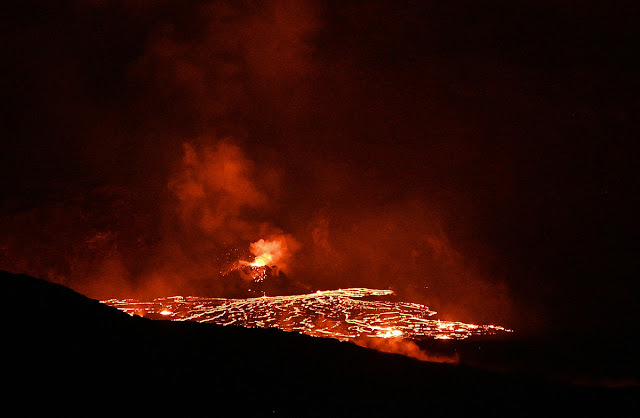
—captivated by the slow unfolding of each orange wave as it flows forward, the way the dark edges set and hold and then burst again, letting the next bright line break free.
So yes, I knew I would love the lava. What I was unprepared for was the way its inexorable twisting, surging motion has been caught and held in the shapes of the cooled lava rock as well! You see lava rock it bits and pieces all over the island, of course, but it's particularly amazing to see the big lava flows where you can trace the length of the lava's path and imagine its motion. From some vantage points you can see all the way down to where the black land juts into the ocean, where the coastline is still being built inch by inch with every new eruption.
Walking over the lava and seeing that new earth growing into the ocean was a deeply spiritual experience for me. Part of what I felt was just awe at the stark beauty and pure power of God in nature. In one area, we hiked around on the lava flows from 2018, when a bunch of fissures opened in the earth and lava rivers poured out to swallow roads and cars and houses. So recent, so present. How can you not marvel at the upheaval caused by liquid stone as it blazes a path through trees and foliage, superimposing canyons and hillsides, destroying anything manmade?
But then—I kept wondering—is destroying really the right word for what happened here? The 2018 Kilauea eruption created 875 new acres of land, as high as 919 feet in some places, I read. That new land is strange and beautiful—you'll see a hundred pictures of it here. Creation or destruction, then?
On the eve of sending my oldest child off into the world, with my emotions constantly close to the surface, the symbolism was almost too much for me. I've been trying to write and sort out my thoughts ever since I walked those lava fields, and my thoughts keep cycling around creation and destruction, beginnings and endings. Aren't we all Adam and Eve leaving Eden to create a place of our own? When I think back over all these years of motherhood, I can see the slow destruction of my babies as the layers of time and experience cover them—creating something new, certainly, but also losing those early layers as surely as if they'd been swallowed by lava. It's not something you can explain to the children themselves. They think they're the same people they always were. And yes. It's true that there's something consistent there—the germ, the seed, the spirit. I realize that what I see in mortality is only a slice of who they really are. Also, of course, as they grow up, I'd hate them to think I don't appreciate who they are now. I do! There comes a point in older childhood when every child realizes he's not as cute as he used to be, and I always try to be extra reassuring to my children at that point: oh no, you're even better now—so smart, so fun, so funny. I wouldn't trade you for your baby self. The current you is too delightful.
It's mostly true when I say that. And occasionally one of the children's past selves was difficult enough that I really am relieved to see it go. But what I
don't tell them is that I've started to see each self as almost a living ghost, born only to start immediately fading. It's why as I get older, I cling to them a little longer, try to take their pictures, embarrass them with words like these. Even then it hardly seems to be enough. Where is
this Abe now? And
this one? And
this one?
And what I
can't tell them is that sometimes the ache of where those previous selves used to be burns like a gaping hole in my heart. It's not quite like a death. But there's death in the air around it.
Neil Peart has words for it, of course:
In the rise and the set of the sun
As the stars go spinning, spinning round the night
It is what it is, and forever
Each moment a memory of light
The arrow flies while you breathe
The hours tick away, the selves tick away
The watchmaker has time up his sleeve
The hours tick away, they tick away
But they don't tick away forever—right? Because the watchmaker
does have time up his sleeve? It's one thing I hold onto, when I think of eternity; I guess you could say it's part of my testimony. At least, it's a hope I cling to—that somehow, in some form, the good parts of those past selves will
live again, that
what was lost will be restored. That someday, we will go
home again, and
home will be everything it was and everything it should have been, all at once.
Abe's leaving on his mission in a week (he may be gone already, by the time I manage to get these thoughts sorted through and publish this). I don't think he'd love the idea that any part of his mission is about ME. Ha! I only hope that by the time he reads this he can begin to understand—because in ways I'm only beginning to understand myself, his leaving is about me as well as him—my sacrifice, my refinement, my progression.
I knew I would have to give things up for my children. But to continually give them up to their next selves…I didn't comprehend what that would mean. Somehow, I didn't foresee how inevitably it would lead them away—until what began as part of my very breath and body and soul becomes wholly new and wholly its own.
I'm also aware that I'm only halfway through this journey, in multiple ways. One child leaving home—eh, what's that? I don't know what it's like once they're all gone. I don't know what it's like to lose children to death, or to mourn their complete loss of faith. And I don't know what it's like to have them turn back to me, to grow into consecration, to begin to share the journey of parenthood, to see them lose and find treasures of their own. All of that may still be ahead. She's just a child herself, my mom said once to me a little disapprovingly about a mother she knew, but almost every day I think to myself, That's what I am too.

Parents always laugh about how their oldest children bear the brunt of their inexperience, and it's still true with Abe even now—I don't know how to mother a young adult. I'm a child at it. It astounds me to realize, after all the things I learned in my first forty years, that there's that much again I still don't know! Forty times forty more lifetimes couldn't hold it all. And most of what I do know seems impossible to pass on. But the other thing I felt so viscerally on the lava fields was a sense of time and scale; inklings about change and how God might see it. We watched a volcano documentary where scientists were taking samples of the lava. They plunged metal shovels into the glowing river, lifting it like you'd lift a shovelful of dirt or mud—but it isn't mud, it's rock, with all the heft and mass of rock, and they stagger under the weight of it—and it's only then that it suddenly strikes you: something is wrong with this; the rock is flowing. It's so foreign to everything we "know" from everyday experience.
As you stand on the hardened lava fields you can almost feel time shift, and imagine the rock still flowing around you, eddying like water—movement where there should be no movement, change where there should be permanence. I can't help wondering: is this how God sees the ancient landforms—always in motion? As our years narrow to his days, does he see the mountains sliding into hills, erosion compressed into landfall, and weathering applied like instant lacquer to the stones? Is the most fixed of landscapes actually ephemeral—what seems to us immutable flowing like lava over His eternal landscape?
I think maybe God hints at that view when He prophesies about the Last Days here:
And also that of element shall melt with fervent heat; and all things shall become new, that my knowledge and glory may dwell upon all the earth.
It's strange thinking about what that might mean—"all things becoming new." A hopeful phrase, but with loss inherent in it—that fervent heat destroying what came before. Am I really ready to melt into a new creature, with everything that will entail? I said before that my children don't know they're changing from year to year—well, neither do I, for the most part. I always feel like ME. Of course I've run up against the refining process by now, and it has been painful, leaving selfish parts of myself behind. I haven't managed to shed them all yet. But mostly, it feels like I'm still so much who I've always been. I don't even know how many of my selves have slipped away. Does God mourn the loss of any of them? Does he see me flowing and changing, even now? Does he see destruction in it, or only glorious creation?
I like to think God sees the best parts of all of me preserved in who I will someday become. And I'm trying to trust that I'll see it too in my children—after the fire flows through us.
* * *




.JPG)